
Breastfeeding/chestfeeding is the biological, natural way to provide infants with the nutrition they need to grow healthy and strong. Breastfeeding/chestfeeding benefits not only the child but also caregivers and the community.
Health Canada and the Thunder Bay District Health Unit recommend exclusive breastfeeding/chestfeeding for the first six months, followed by continued breastfeeding/chestfeeding for two years or more, alongside the introduction of solid foods around 6 months.
Whether you're preparing for your baby’s arrival, navigating the early stages of breastfeeding/chestfeeding or nursing an older child, we're here to provide helpful information and support at every stage of your lactation journey. Below, you will find a range of resources divided into three sections to guide you through the prenatal, early postpartum, and older infant stages of breastfeeding/chestfeeding.
Prenatal: Preparing to Breastfeed/Chestfeed
- Meet with a nurse from TBDHU’s Lactation Program before delivery to address any questions or concerns about breastfeeding/chestfeeding
- One-on-one consultations can be scheduled to discuss your personal infant feeding plan
- To schedule a prenatal consult call TBDHU Lactation Services (807) 625-8827 or Toll-free 1-888-294-6630 or contact us by email at: lactation@tbdhu.com.
- Click here for more information about services offered by TBDHU’s Lactation Team
Feeding My Newborn - Prenatal Lactation Class
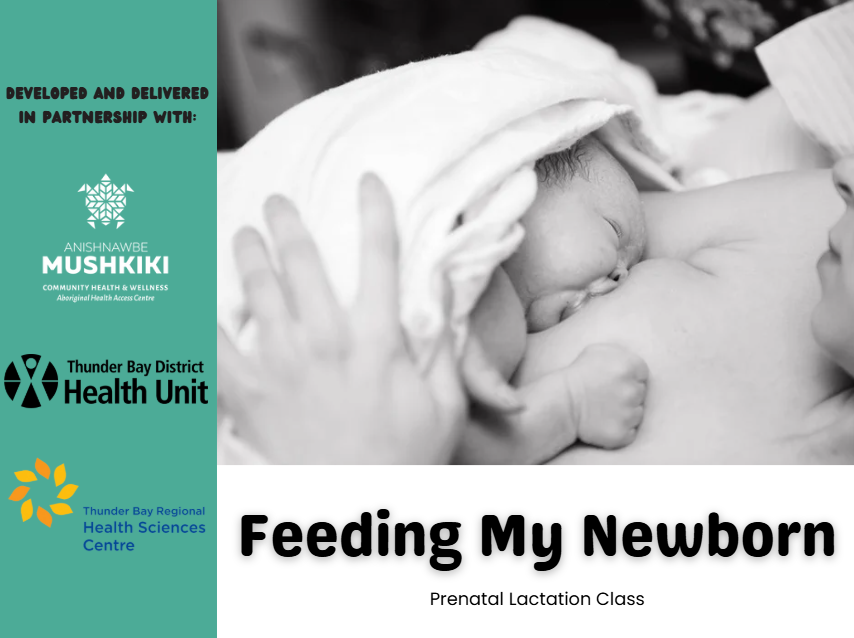
- Learn the basics of breastfeeding: positioning, latch, colostrum collection, and managing common challenges
- In-person class
- Free of charge
- Recommended after 20 weeks gestation
- Click here to register
Bump to Baby – Online Prenatal Program
A FREE online prenatal program developed by public health professionals through Southeast Public Health Unit. Expectant parents can learn about pregnancy, labour and birth, and caring for a newborn!
- Engaging videos & interactive tools
- Up-to-date, evidence-based information
- External links to Canadian Resources
- Learn at your own pace
Prenatal Hand Expression and Colostrum Collection
Prenatal hand expression, recommended for most low-risk pregnancies after 36 weeks, helps prepare for breastfeeding/chestfeeding and may collect colostrum for the early days. While it may take practice and you might not collect colostrum, it’s still beneficial. Practicing hand expression can make breastfeeding/chestfeeding easier and support your body in producing more milk sooner.
Speak with your healthcare provider before beginning prenatal hand expression.
- Prenatal Colostrum Collection (La Leche League Canada) PDF
- Prenatal Hand Expression Video – More Milk Sooner
| Prenatal Breastfeeding/Chestfeeding Resources |
|---|
| Breastfeeding Matters – An important guide to breastfeeding families (Best Start) PDF |
| Breastfeeding for the Health and Future of our Nation: A booklet for Indigenous families (Best Start) PDF |
| Lactation Support Services in Thunder Bay (TBDHU) PDF |
| Baby Feeding Cues (Metro North Health) PDF |
| Prenatal Colostrum Collection (La Leche League Canada) PDF |
| Positioning and Latching (La Leche League Canada) PDF |
| How Partners and Supporters Can Help – La Leche League Canada |
| VIDEO LINKS |
| First Droplets – Prenatal Breastfeeding/Chestfeeding Videos |
| How to Express Breastmilk (English) – Global Health Media |
| Meeting Baby for the First Time – Unicef UK Baby Friendly Initiative |
| The Latch – Peel Region Public Health |
| What to do When – Peel Region Public Health |
Getting Started Breastfeeding/Chestfeeding
Breastfeeding/chestfeeding is natural but it can take a little time for breastfeeding/chestfeeding individuals and babies to learn. The following resources are designed to assist you in these early days of lactation:
The “Golden Hour”
The "golden hour" refers to the first hour after birth, a critical time for skin-to-skin contact, promoting bonding, regulating baby’s temperature, and supporting breastfeeding/chestfeeding.
Watch a video of The First Hours here.
Feed baby as soon as possible after birth
- Early breastfeeding/chestfeeding will send signals to your body to increase milk production
- Most babies will show hunger cues and attach at the breast within the first 1 -2 hours
- The first milk, called colostrum is packed with essential nutrients and antibodies, making it easy to digest. Colostrum gives your baby a strong immune boost, helping to protect against infections and diseases
Watch video of baby doing the breast/chest crawl in the first hours
Immediate and uninterrupted skin-to-skin contact
- Immediate and uninterrupted skin-to-skin contact during the first hour after birth creates the ideal foundation for a successful breastfeeding experience
- Learn more about Skin-to-Skin Contact
Feed Baby Frequently
- Babies need to feed frequently, a minimum of 8 times in 24 hrs, but it is common for baby to feed more frequently
- Frequent feeding day and night supports their rapid growth and promotes milk production
- The more often a baby nurses, the more milk the breastfeeding/chestfeeding person’s body will produce.
Rooming-In (sharing the same room)
- Sharing a room with your baby is recommended for up to the first 6 months
- Rooming-in allows your baby to remain close by, and lets you learn and respond to your baby’s early feeding cues
- Baby’s feed best when they are offered the breast/chest at the earliest signs of hunger
Learn to hand express breast/chest milk
- Hand expression is a good way to collect colostrum (first milk)
- Hand expression can help promote your milk supply
- Hand expressing to soften full breasts/chest can relieve symptoms of engorgement and prevent congested milk ducts
- Learn more about hand expression
Importance of Skin-to-Skin
"Skin-to-skin" means to place your baby against your bare chest while your baby is wearing just a diaper. You can keep the baby warm by placing a blanket over their back. Keeping your baby skin-to-skin after birth is better than keeping them swaddled in a blanket. All child caregivers are encouraged to practice skin-to-skin.
Skin-to-skin is important because it helps to:
- Get breastfeeding/chestfeeding off to a good start
- Increase breastmilk/chestmilk supply
- Keep baby comfortable and reduce crying
- Stabilize baby’s heart rate, temperature and breathing rate
- Stabilize baby’s blood sugar
How to practice skin-to-skin safely:
- Sit or lay slightly upright, in a comfortable position
- Turn your baby's face to one side in a position that allows baby to breathe easily
- Make sure you can see your baby's nose and mouth
- Tuck baby's legs up and bring their hands up near baby's face
- Cover your baby's back with a thin blanket
- Let your baby stay on your chest for as long as possible while you are awake
For more information about how to safely practice skin to skin contact visit Skin to Skin Contact for Babies and Young Children – (La Leche League International)
Baby Feeding Cues
Feeding cues are the signs your baby gives to show you when they are ready to feed and when they have had enough to eat.
How often and how long babies feed is determined by your baby’s needs and cues. Newborn babies usually feed every 1-3 hours, 8 or more times in 24 hours.
Feed your baby when you see these early feeding cues:
- Eyes and eyelids moving in light sleep
- Bringing hand to mouth
- Turning head and rooting (reaching with mouth)
Responding to your baby's cues will help to make breastfeeding/chestfeeding easier. It will also help build a good milk supply and prevent full breasts (engorgement). Your baby will probably cry less and gain weight faster. For more information on feeding cues:
- Feeding Cues and Behaviour (Video): describes how you can tell when your baby is hungry and respond to their feeding cues.
- Feeding Cues Chart (PDF): pictures that show how your baby will tell you they are hungry.
Signs That Baby is Getting Enough
Many parents who are breastfeeding/chestfeeding worry that they won’t be able to know for sure if their baby is "getting enough." Fortunately, there are signs that indicate your baby is receiving enough milk.
Your baby is getting enough milk if they:
- Feed at least 8 times in 24 hours (frequent feedings are normal, feed baby whenever they show hunger cues)
- Latch on deeply and suck strongly
- You can hear them swallowing (a “ca-ca” sound)
- Have an adequate number of wet and dirty diapers (see chart below for expected output for baby’s age)
- Appear satisfied after feeds
- Are gaining weight as expected
Expressing and Storing Breastmilk/Chestmilk
If breastfeeding/chestfeeding doesn't go as planned or your baby is not ready to breastfeed/chestfeed right away, it’s important to learn how to express your milk to feed your baby. Learn from your nurse or lactation consultant about how to give your baby your milk from a spoon or a cup until your baby learns to breastfeed/chestfeed well.
Hand expression is a way to collect your breast/chest milk. No buying or sterilizing equipment is required. Just wash your hands and use a clean container like a spoon or a cup. It’s a useful skill new parents can learn with a bit of practice. Before you know it, you will be able to use hand expression easily.
Reasons to Hand Express Include:
- To prevent/relieve symptoms of engorgement
- To express a few drops to get baby interested in latching
- To maintain or increase milk supply
- Prevent congested milk ducts/mastitis
- Express milk if separated from baby
- It is the most effective method to express colostrum, which is collected in small amounts and is thicker than mature milk
- No pumping equipment needed
Follow the links below for more information on hand expression:
- How to Hand Express (Stanford Medicine) Video
- 7 Steps of Hand Expression
- Cup Feeding for Small Babies demonstrates cup feeding technique for expressed breastmilk/chestmilk
| Resources to learn more about expressing, pumping and milk storage |
|---|
| How to Hand Express (Stanford Medicine) Video |
| Hands-on Pumping (Stanford Medicine) Video |
| Hands-on Pumping Tip Sheet (Lactation Education Resources) |
| 7 Steps to Hand Expression (TBDHU) |
| Breast Pump vs. Hand Expression – La Leche League Canada |
| Expressing and Storing Breast/Chest Milk – (Best Start) |
| Exprimer et Conserver le Lait Maternel – (Best Start) |
| Storing Human Milk (La Leche League Canada) |
Note: If you're using a breast/chest pump, it's highly recommended to consult with a lactation professional (link to TBDHU lactation clinic section) for flange sizing. This ensures the best fit and comfort, which can help optimize milk expression.
Positioning and Latch
Proper breastfeeding positioning and latch are essential not only for your comfort and your baby's feeding but also for promoting and maintaining a healthy milk supply. This section provides practical tips to help you find the right position and achieve a deep, effective latch.
- Positioning and Latching Tip Sheet (La Leche League Canada) PDF
- Laid Back Breastfeeding (Biological Nurturing®) (Middlesex-London Health Unit)- PDF
- Breastfeeding Matters (Best Start) PDF
- The Latch (Region of Peel)
- Breastfeeding Positions (Region of Peel) Video
- Breastfeeding with Large Breasts (Lactation Education Centre) PDF
Other Ways to Feed Your Baby Breast/Chest Milk or Supplement
If your baby can’t latch right away, don’t worry—this can happen for many reasons. Some babies may need to be fed using other methods like cups, spoon, tubes, or bottles until they're ready to breastfeed/chestfeed. With support and time, most babies can learn to feed at the breast/chest. See the resources below about other ways to feed your baby expressed milk/supplement.
- Cup Feeding (La Leche League Canada) PDF
- Nourrir Aux Goblet (La Leche League Canada) PDF
- Cup Feeding Your Small Baby (Gobal Health Media Project) Video
- Video of Cup Feeding (ibconline.ca) Video
- Spoon Feeding Breastmilk to a Newborn (IABLE) Video
- Finger Feeding to Latch (ibconline.ca) Video
- At Breast Supplementation (ibconline.ca) Video
- At Breast Supplementation Tip Sheet (Hamilton Health Sciences) PDF
- Paced Bottle Feeding (Peel Region) Video
If you are using alternate feeding methods, we recommend connecting with a lactation professional (link to TBDHU lactation clinic page) who can help support you to meet your infant feeding goals.
Breastfeeding/Chestfeeding During Painful Procedures
- Breastfeeding or chestfeeding during painful procedures can help your baby cry less and feel less pain
- Start by undressing the baby for the procedure
- Begin breastfeeding or chestfeeding before the procedure, making sure the baby has a good latch
- Keep nursing during and slightly after the procedure for the best comfort
Breastfeeding to Minimize Vaccination Pain (CHEO) Video
Vitamin D for Breastfed/Chestfed Babies
Breastfed children under 2 years old should receive a daily liquid vitamin D supplement of 400 IU (10 mcg) until they are getting enough vitamin D through food.
Priority populations that are at higher risk of vitamin D deficiency and may require additional supplementation.
Babies who are formula-fed or drinking cow’s milk typically do not need a supplement, as these products already contain vitamin D.
These supplements are commonly available as liquid drops at most pharmacies
Vitamin D – (Canadian Pediatric Society) - Webpage
La Vitamine D - French (Société canadienne de pédiatrie) - Webpage
Reference: https://www.odph.ca/PNG
Birth Control and Breastfeeding/Chestfeeding
Can Breastfeeding/chestfeeding be used as a Method of Contraception (birth control)?
Yes. Breastfeeding/chestfeeding can be used for birth control, but only if you answer “Yes” to ALL of the four statements below:
- My baby is less than 6 months old.
- I have not had a period since my baby was born.
- My baby is fully or nearly fully breastfed/chestfed.
- I breastfeed/chestfeed at least every 4 hours during the day and at least every 6 hours at night.
If you answer “No” to any of these statements, begin another method of contraception.
Fully breastfed/chestfed means your baby gets all food from suckling at the breast/chest. Your baby must feed at the breast/chest; pumping breastmilk/chestmilk does not have the same effect.
Nearly fully breastfed/chestfed means your baby gets most food from breastfeeding/chestfeeding. Vitamins, minerals, juice, water and some other foods (but no more than one or two mouthfuls a day) are also given.
This method of contraception is called Lactational Amenorrhea Method:
L = Lactational means breastfeeding/chestfeeding
A = Amenorrhea means having no monthly period
M = Method
To use LAM effectively, you need additional detailed information. For more information on LAM and other methods of birth control, call: Healthy Babies Healthy Children Lactation or the Sexual Health Clinic at 625-5900.
Below is a link to a PDF describing hormonal and non-hormonal methods of birth control, their effectiveness, and their effect on breastfeeding/chestfeeding:
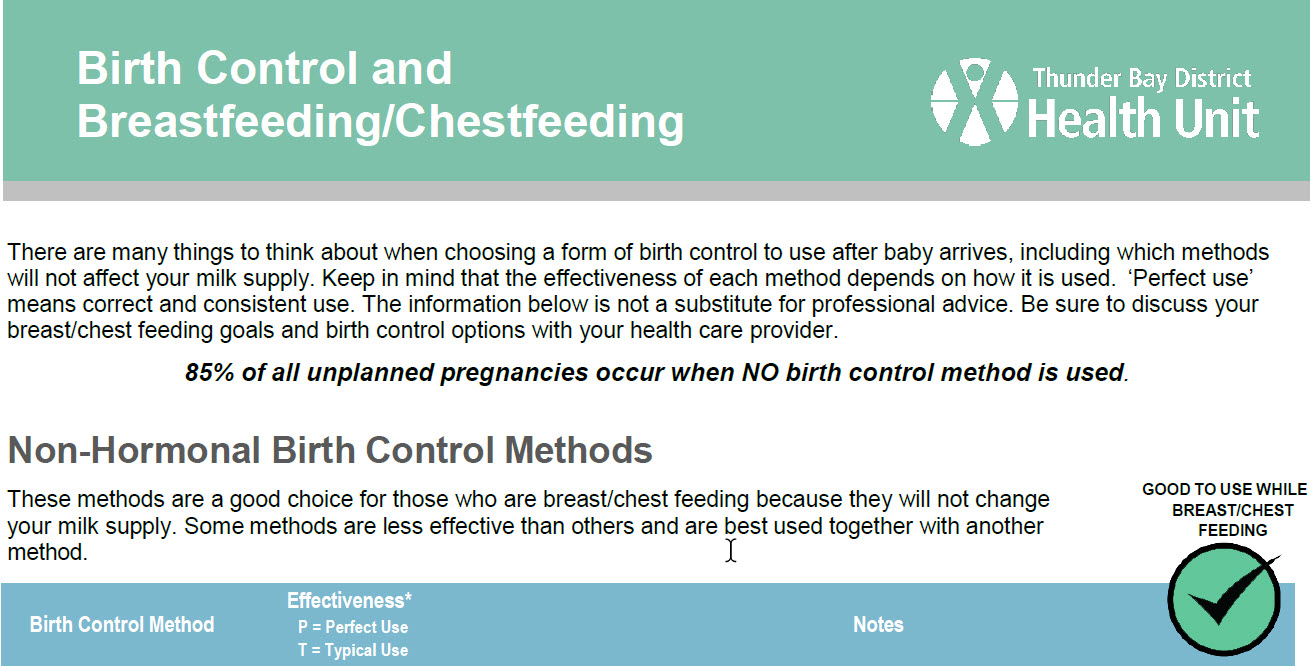
Your doctor, nurse practitioner, or a lactation consultant can help you decide which form of birth control is right for you while you are breastfeeding. If you are considering a hormonal method of birth control, it is important to consider selecting a short acting form (e.g. the pill), rather than a long acting form (e.g. the shot), as the results may be reversed more quickly if they are having an impact on your milk supply.
Returning to Work or School
Whether your maternity leave is short or extended, continuing to breastfeed after returning to work or school is both possible and beneficial. It promotes better health and well-being for both you and your baby. In fact, workplaces also benefit—breastfed babies tend to be healthier, leading to fewer employee absences and a boost in workplace morale.
It's important to know that employers have a legal obligation to support breastfeeding employees. They must make reasonable accommodations unless doing so would result in significant cost or pose a serious risk to health and safety.
Tips to prepare to return to work or school while breastfeeding/chestfeeding:
- Know your rights
- Returning to Paid Employment – La Leche League Canada
- Hand Expression and Pumping (link to content under this anchor)
Introducing Solids
Breastmilk provides all the nutrition your baby needs for healthy growth and development during the first six months of life. Introducing other foods or liquids during this time may reduce milk supply and could lead to early weaning.
Exclusive breastfeeding means your baby receives only breastmilk along with any necessary vitamins or medications — no other foods or drinks — for the first six months.
Around 6 months of age, most babies are ready to start solid foods. At this stage, breastfeeding can continue alongside other foods and is recommended up to two years of age or beyond.
If you have made an informed decision to use infant formula, whether partially or exclusively, the timing and approach to introducing solid foods remain the same as for babies who are breastfed.
Your baby may be ready for solid food when they:
- Can sit up, hold their head steady and lean forward
- Open their mouth wide when you offer food
- Can pick up food and try to put it in their mouth
- Can let you know when they don’t want food by turning their head away
Resources about starting solid foods:
- Feeding Your Baby – A Guide to Help You Introduce Solid Foods (Nutrition Connections) PDF
- Starting Solids and “Baby-Led Weaning” (La Leche League Canada)
- Trust Me, Trust My Tummy (Toronto Public Health) Video
- Pediatric Nutrition Guidelines for Health Professionals – Birth to Six Years (ODPH 2025) PDF
- Division of Responsibility in Feeding (Ellyn Satter Institute) PDF
Tips on Responsive Feeding—following your baby’s lead at mealtimes
Children are naturally equipped to sense when they’re hungry or full, and it’s important for caregivers to recognize and respond to these cues to help prevent underfeeding or overfeeding. Practicing responsive feeding and following the division of responsibility in feeding can support a child’s ability to self-regulate their intake, promote a healthy weight, and foster a positive relationship with food over time.
For additional information about infant and child nutrition visit Feeding Young Children.
Weaning Support
There is no specific recommended time to wean your baby or child — it’s a personal decision that should be based on what feels right for both you and your child.
- Weaning – How to Stop Breastfeeding (La Leche League)
- Weaning Your Child From Breastfeeding (Caring for Kids)
- Sudden Weaning for Medical Reasons (La Leche League)
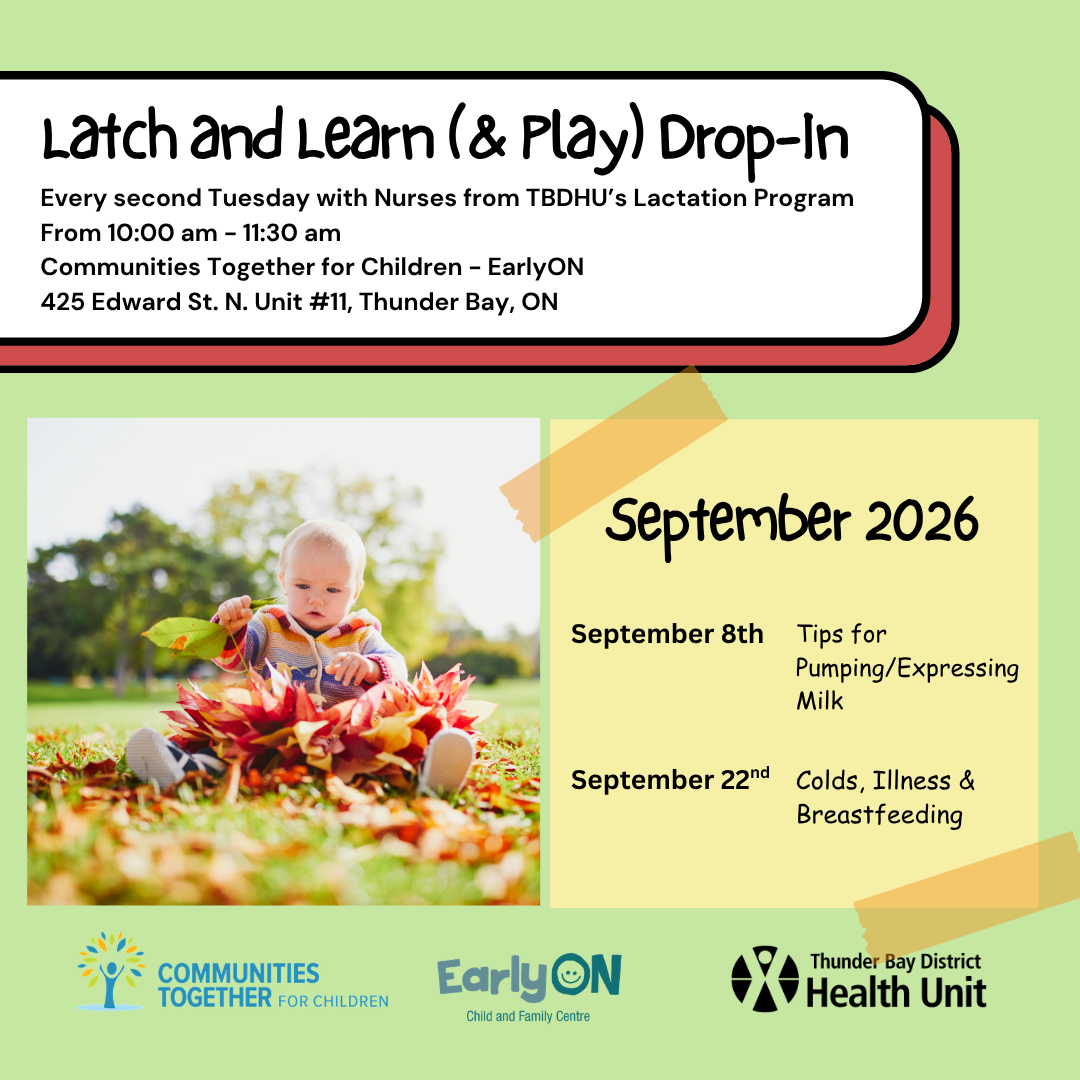
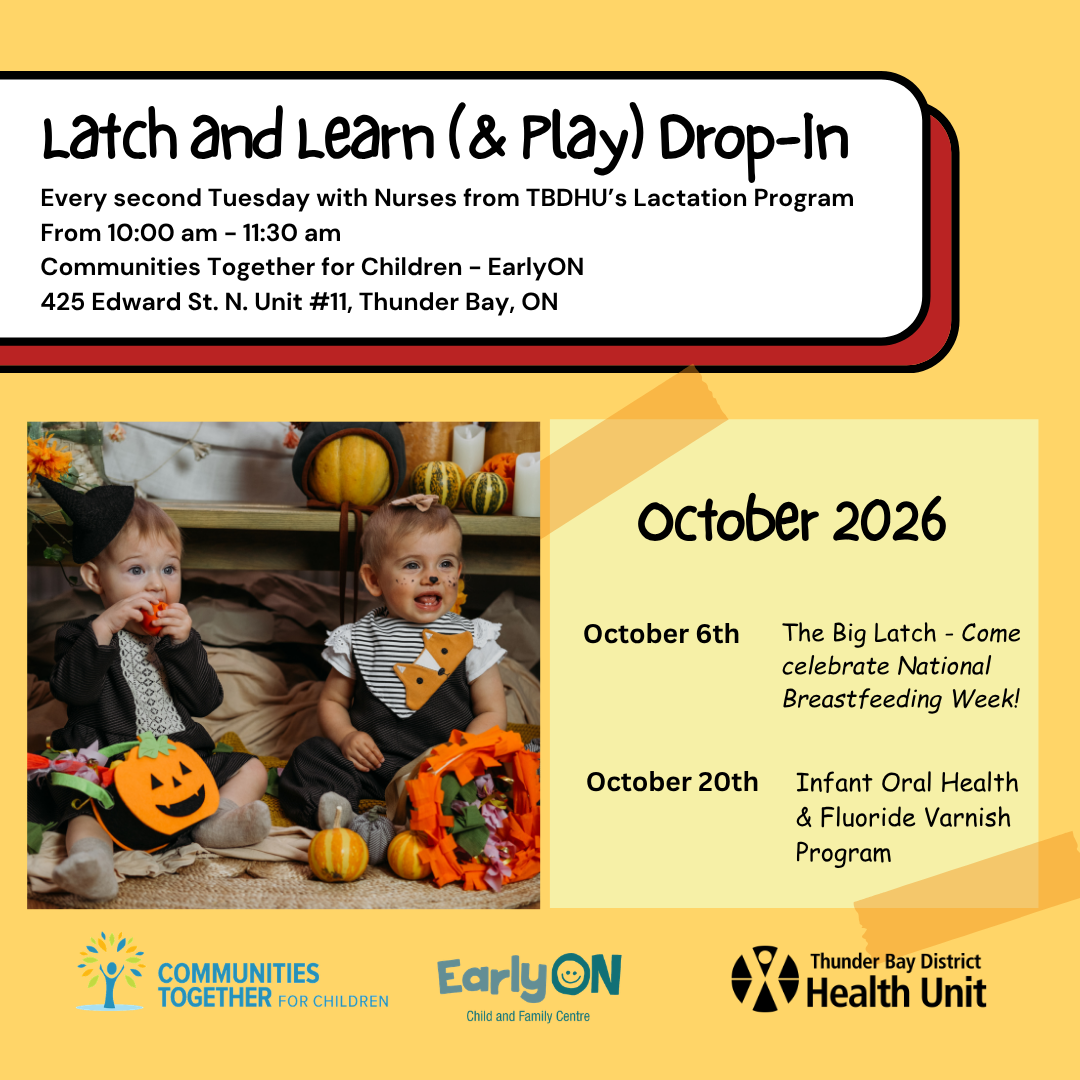
Latch n' Learn Drop-in Lactation Playgroup
Join our Lactation Drop-In Support Group, a welcoming space for anyone preparing to breastfeed or chestfeed, as well as those currently nursing a child of any age. This group provides peer support and access to evidence-based information to help you navigate your feeding journey. Whether you're a first-time parent or a seasoned caregiver, come connect with others in a supportive environment. Sibling children are welcome to join the playgroup, making it a family-friendly experience.
A Public Health Nurse from TBDHU's Lactation Program will be attending every second Tuesday to facilitate a discussion on a breastfeeding/chestfeeding topic and provide valuable resources about feeding your baby.
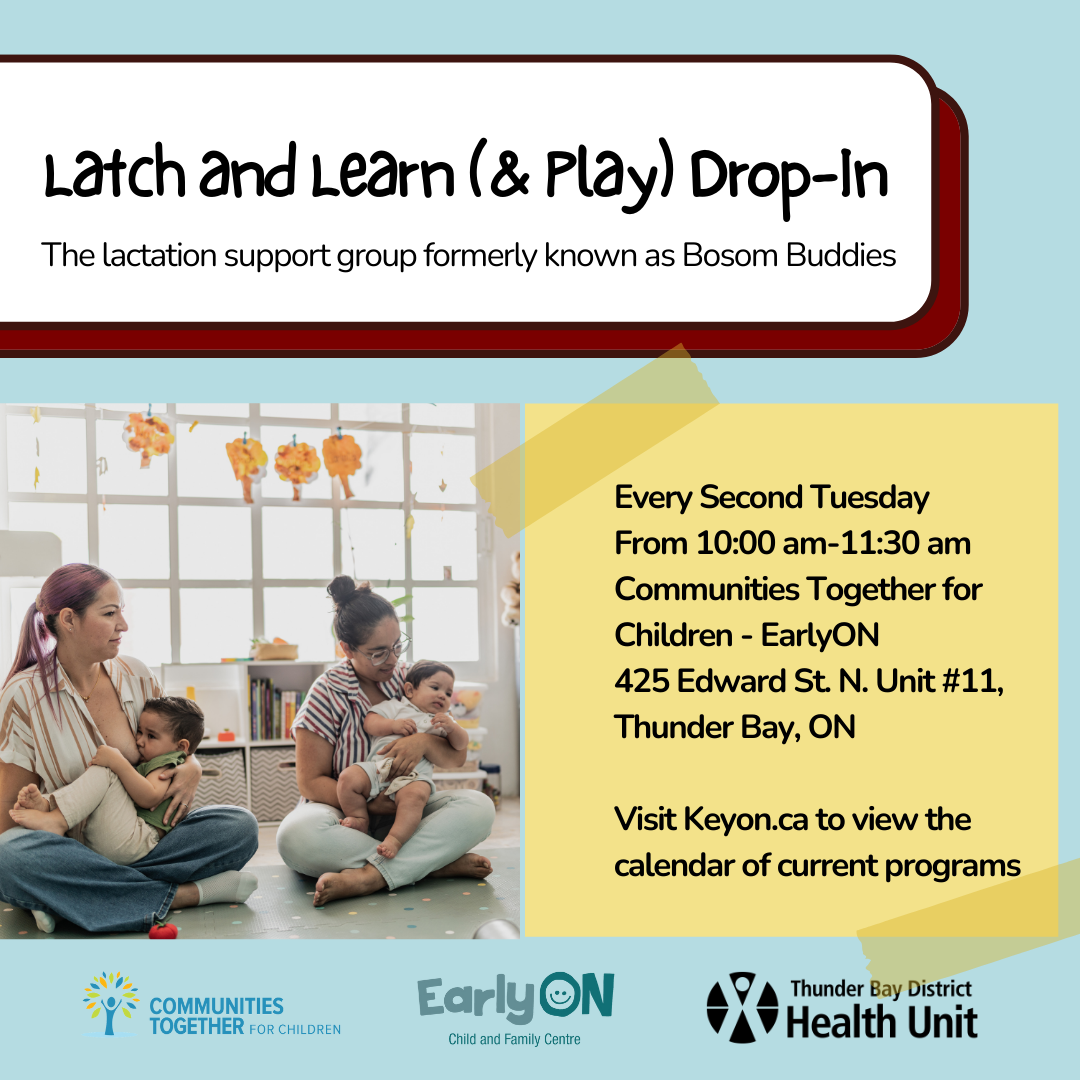
When and Where?
Every second Tuesday from 10:00–11:30 AM
September 2026:
- Tuesday Sept 8 (tips for pumping/expressing milk)
- Tuesday Sept 22 (colds, illness and breastfeeding)
October 2026:
- Tuesday Oct 6 (The Big Latch - Celebrating National Breastfeeding Week)
- Tuesday Oct 20 (Infant oral health and fluoride varnish program)
Communities Together for Children EarlyON and Family Centre, 425 Edward Street N, Suite #11, Thunder Bay (Northwood Park Plaza. The entrance is the door in the corner near the Bank of Montreal)
To view the most up-to-date programing and site closures visit Communities Together For Children’s calendar at www.keyon.ca
Brought to you by CTC EarlyON and the Thunder Bay District Health Unit, this support group offers a nurturing space for individuals nursing infants or children. Don't miss this opportunity to connect, learn, and grow together.
We look forward to seeing you there!